
Cement “decarbonization” is making the rounds: it proposes to crack ammonia at 600 bar, hit lime with supersonic nitrogen, cook the result into calcium nitrate in Inconel hardware. The more complex and expensive, the louder the shout.
The fuel is ammonia. It arrives by tanker or pipe, made from natural gas. The “zero transport hazard” is the same hazard, moved to the gate. The nitrogen in the fertilizer is bought, so the plant stays a customer of the gas market. And the CO2 released when limestone is calcined does not care what you do with the fuel.
Potassium does not burn out in a kiln. It evaporates at about 1 000 °C, condenses in the preheater and circulates until rings and buildup stop the line. So plants with a chlorine bypass pull it out as dust, rich in potassium and chlorine and loaded with lead, cadmium and thallium. It cannot go back into the kiln. It goes to landfill. The US alone generates around 13 million tonnes of kiln dust a year, and landfills about 3 million tonnes of the surplus. In India, the potash sitting in kiln dust could cover the entire import. Worldwide, cement is 4.2 billion tonnes a year, and kiln dust runs 15–20% of that mass: a potash resource on the order of half of world consumption.
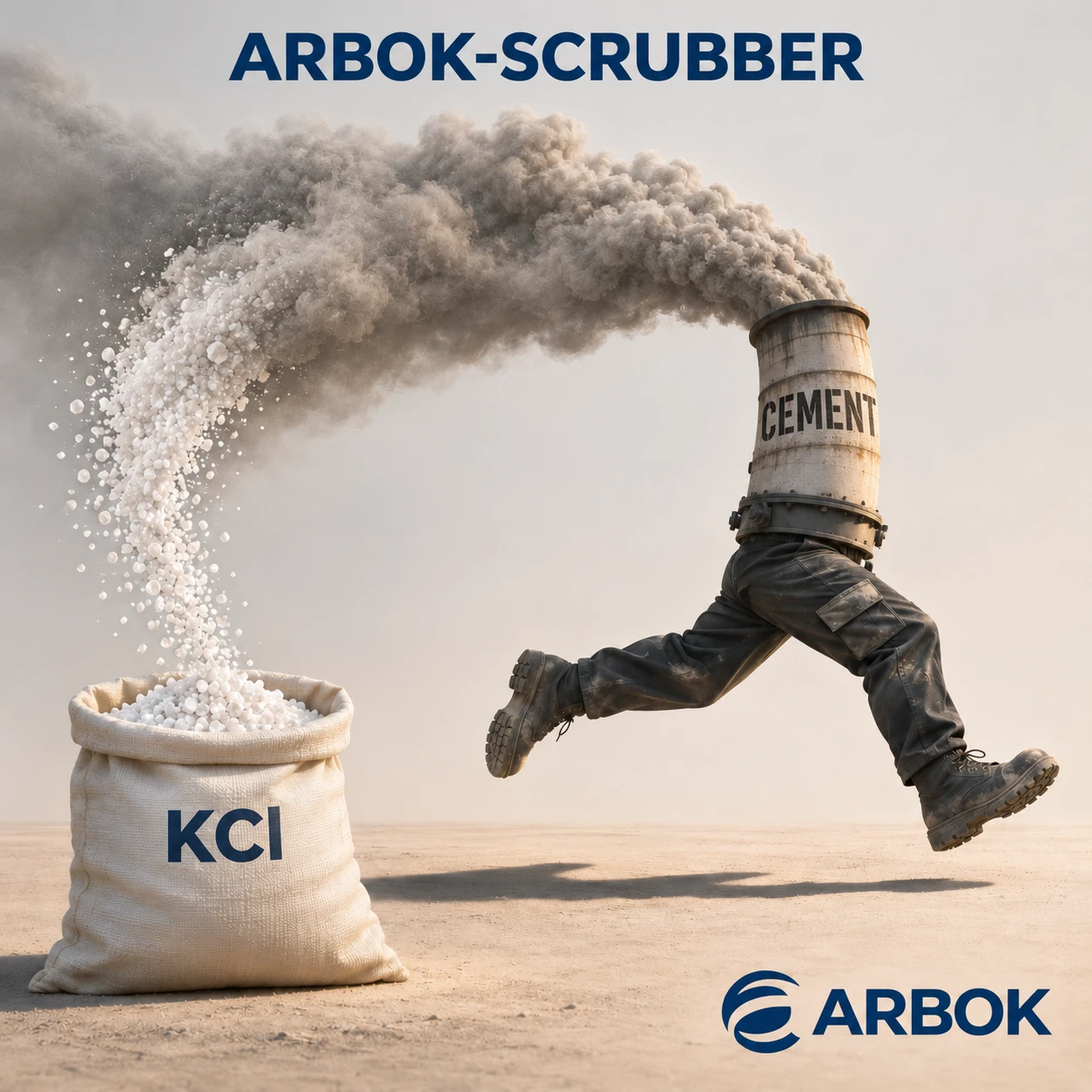
🟢 Arbok-Scrubber is designed to turn this dust into potassium fertilizers. Water captures it at the bypass, then the mixture goes into the Arbok vacuum module at deep vacuum and ambient temperature. No 600 bar. No 374 °C. No Inconel. No membranes, no reagents, no second sludge. Only water vapour leaves the stack. Water returns to the scrubber clean, up to 99.98% by volume. The “dust” leaves dry and chlorine-free, and now returns to the kiln as raw meal. The brine crystallizes in fractions: KCl, K2SO4, NaCl and separate, mutually isolated concentrates of heavy metals: lead, cadmium, thallium.
One 20-foot container beside the kiln. 200 m3 of water a day, 0.72 kWh per m3, service life 15–20 years. Two operators per shift shared with the plant, offered on a per-tonne fee or BOOM basis.
A kiln of 4 000 tonnes a day produces about 10 000 tonnes of bypass dust a year. At $310–400 a tonne for the chloride and $575–770 for the sulfate, that becomes roughly 2 000 tonnes of potassium chloride, 1 000 tonnes of potassium sulfate and 500 tonnes of salt. Four cost lines (lost raw material, landfill, kiln stops, emission fees) turn into three revenue lines: about $3 million a year per kiln, payback 5–7 years.
In 2026 urea went from $400 to $850 a tonne. Potash from kiln dust follows nothing: it is already inside the country, inside the plant.
About $0.7 million comes from the chloride, $0.6 million from the sulfate, $0.3 million from salt and metals, $0.8 million saved on hauling hazardous dust to landfill, $0.5 million for each kiln stop avoided.
One route buys ammonia to make a fertilizer. The other collects the fertilizer the kiln keeps losing.
#Arbok #Cement #Potash #Fertilizer